What Can Rabbits Eat Daily? Complete Safe Food List (2026)
- Hay makes up 80% of a rabbit’s daily diet — unlimited timothy, orchard grass, or meadow hay every day.
- Fresh leafy greens (roughly 1 cup per 2 lbs of body weight) should be fed daily alongside hay.
- Pellets are optional for healthy adult rabbits — if used, limit to ¼ cup per 5 lbs of body weight per day.
- Fruits and starchy vegetables are treats only — no more than 1–2 tablespoons per day, a few times a week.
- Several common foods — onions, iceberg lettuce, chocolate, and avocado — are toxic to rabbits and must never be fed.
What Do Rabbits Eat Every Day? The Core Diet Breakdown
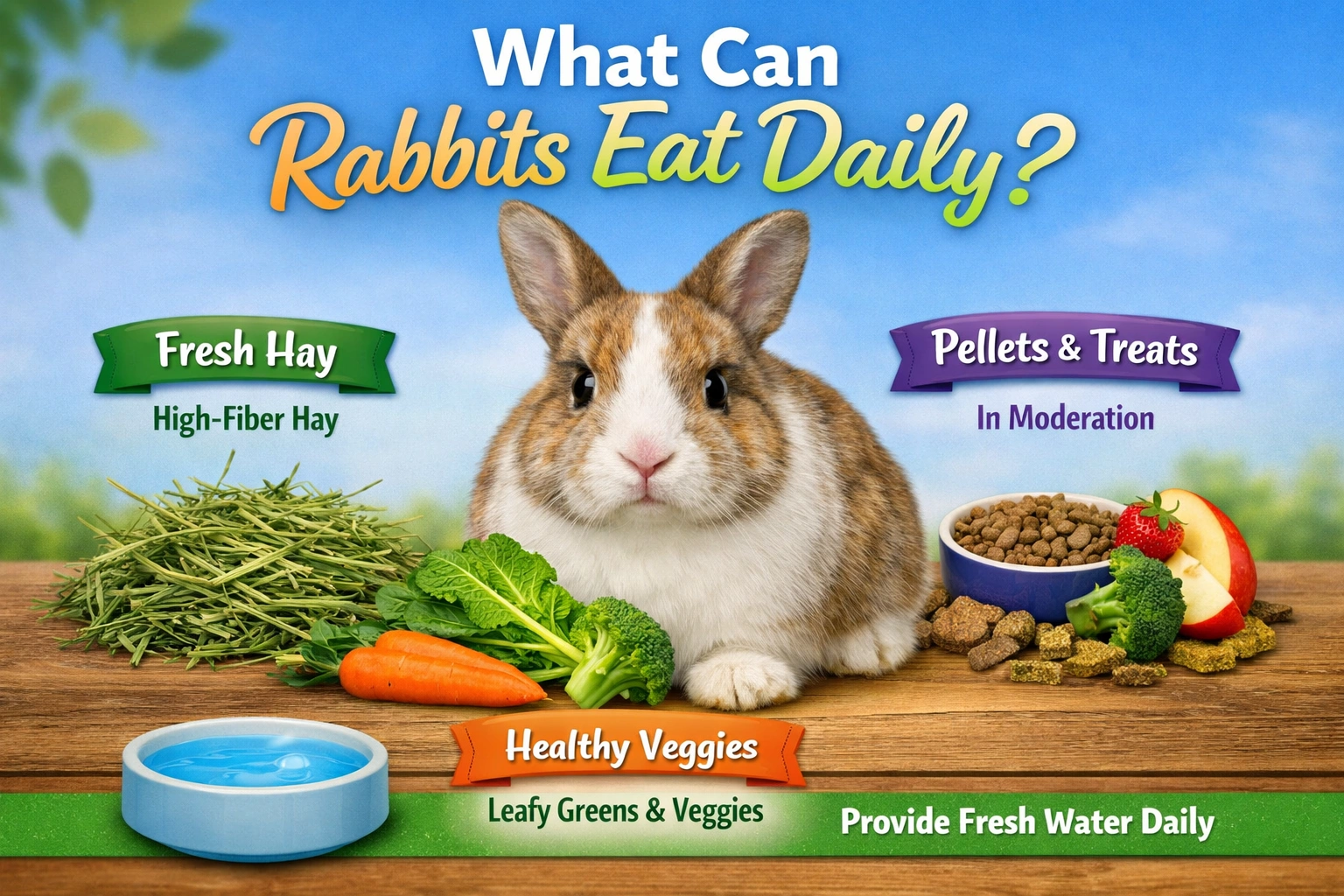
A rabbit’s daily diet has three layers: unlimited hay as the base, a measured serving of fresh leafy greens, and a small amount of pellets. Everything else — fruit, root vegetables, herbs — falls into the treat category and should not be fed in large amounts.
The House Rabbit Society recommends that hay make up 80–85% of a rabbit’s total daily food intake (House Rabbit Society, 2024). This is not optional. Hay keeps the digestive system moving and wears down continuously growing teeth, preventing painful dental problems.
- Meadow Hay vs Timothy Hay for Rabbits
- The Essential Contacts Every Rabbit Owner Should Have
- Orchard Hay vs Timothy Hay for Rabbits
- How Long Can Rabbits Go Without Hay?
- Can Rabbits Survive on Hay Only?
Here is how the daily diet breaks down:
| Food Category | Daily Amount | Notes |
|---|---|---|
| Grass hay | Unlimited | Must be available at all times |
| Fresh leafy greens | 1 cup per 2 lbs body weight | Minimum 3 different varieties |
| Pellets (adult rabbits) | ¼ cup per 5 lbs body weight | Plain timothy pellets only |
| Treats (fruit, root veg) | 1–2 tablespoons max | A few times per week, not daily |
| Fresh water | Unlimited | Change daily; bowl preferred over bottle |
The Best Hay for Rabbits: What to Feed Daily
Grass hay is the single most important food in a rabbit’s diet. Timothy hay is the standard recommendation for adult rabbits because it is high in fiber and low in calcium and protein, which prevents urinary and digestive problems (American Veterinary Medical Association, 2023).
Hay types safe for daily feeding:
- Timothy hay — the best all-around choice for adult rabbits; widely available and nutritionally balanced
- Orchard grass — a good alternative for rabbits that refuse timothy; slightly softer texture
- Meadow hay — a mix of grasses and dried wildflowers; good for variety and enrichment
- Oat hay — higher in fiber; useful for rabbits with loose stools
Hay to avoid for adult rabbits:
- Alfalfa hay — too high in calcium and protein for rabbits over 7 months old; only suitable for young rabbits (under 7 months) and pregnant or nursing does
- Clover hay — also too rich in protein for regular daily feeding
Hay should be stored in a cool, dry place and replaced daily if it becomes damp. Wet or moldy hay causes serious digestive illness.
Fresh Leafy Greens: What Rabbits Can Eat Every Day
Fresh greens are the second most important part of the daily diet. They provide water content, vitamins, and feeding variety. Adult rabbits should get roughly 1 packed cup of greens per 2 lbs (0.9 kg) of body weight per day (Rabbit Welfare Association & Fund, 2024).
Feed a minimum of three different green types at once. Rotating varieties prevents nutrient imbalances and keeps feeding interesting for the rabbit.
Safe Greens for Daily Feeding
These greens are low in oxalic acid and calcium, making them suitable for everyday use:
- Romaine lettuce — high water content, well-tolerated by most rabbits
- Green leaf lettuce — a reliable daily staple
- Red leaf lettuce — safe and enjoyed by most rabbits
- Bok choy — good source of vitamin C; feed in moderate amounts
- Cilantro — well tolerated; useful for rotation
- Dill (leaves and stems) — safe daily; also supports digestion
- Fennel (leaves and stems) — good for variety; the bulb can also be fed in small amounts
- Basil — safe and popular with most rabbits
- Mint — feed in smaller amounts as it is more aromatic; helps with digestion
- Watercress — nutritious but feed in rotation, not as the sole green
- Arugula — safe daily in small portions
- Endive — good rotating option
- Escarole — well-tolerated; mild flavor
Greens Safe in Rotation (Not Every Day)
These greens are nutritious but contain higher levels of oxalic acid or calcium. Feeding them 2–3 times per week rather than daily reduces the risk of bladder sludge or kidney problems (House Rabbit Society, 2024):
- Spinach — high in oxalic acid; rotate with other greens
- Kale — high in calcium; fine in small amounts a few times a week
- Swiss chard — high in oxalic acid; same rotation rule applies
- Mustard greens — feed occasionally, not daily
- Beet greens — high in oxalic acid
- Collard greens — high in calcium
Vegetables Rabbits Can Eat: Safe Options and Portion Sizes
Vegetables beyond leafy greens fall into two groups: low-sugar vegetables that can be fed a few times a week, and starchy or high-sugar vegetables that should only be occasional treats.
Low-Sugar Vegetables (A Few Times Per Week)
| Vegetable | Notes |
|---|---|
| Bell pepper (all colors) | Remove seeds; high in vitamin C |
| Broccoli | Feed in small amounts; can cause gas |
| Brussel sprouts | Small portions only; gas risk |
| Cabbage | Small amounts; can cause gas |
| Zucchini | Well-tolerated; seeds are fine |
| Cucumber | High water content; safe and hydrating |
| Celery | Cut into small pieces to prevent choking on stringy fibers |
| Pea pods (no peas) | The flat pod is safe; the peas themselves are high in starch |
Starchy Vegetables: Treats Only (1–2 Tablespoons, 2–3x Per Week Max)
These are high in sugar or starch. Too much causes digestive upset, obesity, and GI stasis — a potentially fatal condition where the digestive tract slows down:
- Carrots (the leafy tops are actually safe as a daily green)
- Parsnip
- Beetroot
- Sweet potato
- Squash (butternut, acorn)
Fruit Rabbits Can Eat: Safe Options and Limits
Fruit is a treat, not a daily food. The maximum is 1–2 tablespoons per day for an average-sized rabbit (2.5–3.5 kg), and not every day. Fruit is high in sugar, which disrupts gut bacteria and contributes to obesity and dental disease.
Safe fruits to feed as treats:
- Apple (no seeds or core — apple seeds contain cyanogenic compounds)
- Strawberry
- Blueberry
- Raspberry
- Blackberry
- Banana (very high in sugar — keep to a very small piece)
- Melon (watermelon, cantaloupe — remove seeds)
- Pear (no seeds)
- Peach (no pit)
- Plum (no pit)
- Mango (no skin or pit)
- Papaya
- Pineapple (small amounts; contains bromelain which may aid digestion)
- Grapes (seedless; limit carefully due to high sugar)
Herbs Rabbits Can Eat Daily
Many fresh herbs are safe for daily feeding and double as good rotation options for the leafy green quota. These are among the most reliably safe:
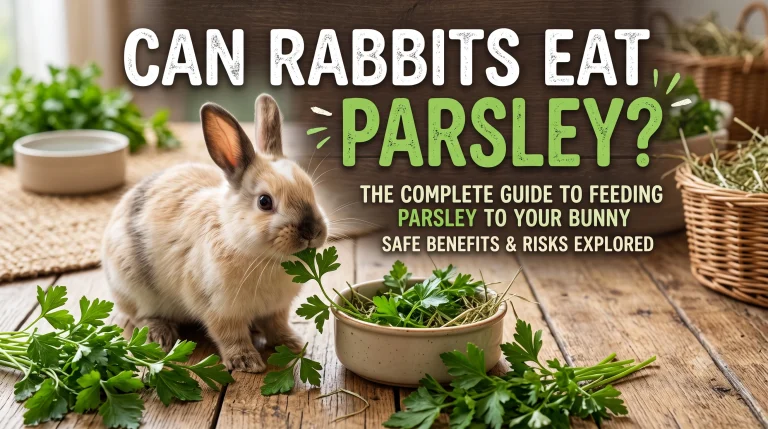
- Parsley (flat-leaf or curly) — feed in moderate amounts; high in calcium, so rotate
- Cilantro
- Dill
- Basil
- Mint
- Tarragon
- Lemon balm
- Oregano (small amounts)
- Rosemary (small amounts)
- Thyme (small amounts)
Foods That Are Toxic or Dangerous to Rabbits
Several foods commonly found in kitchens will harm or kill a rabbit. These must never be fed:
| Food | Why It Is Dangerous |
|---|---|
| Onion, garlic, leeks, chives | Contain compounds that damage red blood cells; can cause fatal anemia |
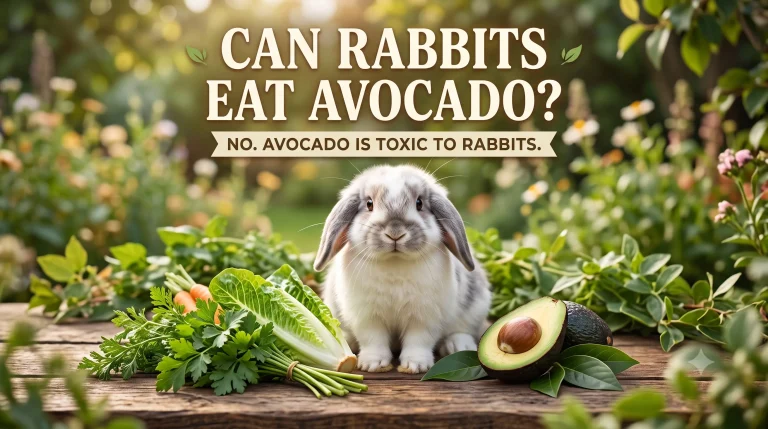
| Avocado | Contains persin, a toxin fatal to rabbits |
| Iceberg lettuce | Contains lactucarium, which can cause diarrhea and sedation in high amounts |
| Chocolate | Theobromine is toxic to rabbits |
| Rhubarb | High in oxalic acid; causes kidney damage |
| Potato (raw or cooked) | High in starch; digestive toxicity risk |
| Tomato leaves and stems | Toxic; the ripe fruit itself is safe in tiny amounts |
| Apple seeds and pits | Contain cyanogenic compounds |
| Sugary snacks, bread, crackers | Starch and sugar cause fatal GI disruption |
| Dairy products | Rabbits cannot digest lactose |
| Meat | Rabbits are strict herbivores |
How to Introduce New Foods Without Upsetting a Rabbit’s Digestion
Introducing new foods too quickly causes digestive upset, soft cecotropes (the special droppings rabbits eat), and in serious cases, GI stasis. The correct method is to go slow.
Step 1: Start with one new food at a time. Add a small amount — around 1 teaspoon — alongside familiar foods.
Step 2: Wait 24–48 hours. Watch the rabbit’s droppings. Healthy droppings are round, dry, and consistent in size. Soft, small, or irregular droppings mean the food is not agreeing with the rabbit.
Step 3: If droppings stay normal, gradually increase the amount over 7–10 days until the food is part of the regular rotation.
Step 4: If droppings change, stop the new food immediately. Return to hay and familiar greens. Wait until droppings normalize before trying again.
Young rabbits (under 7 months) should eat mainly alfalfa hay and age-appropriate pellets. Introduce greens only after 12 weeks, starting with one type at a time (British Rabbit Council, 2023).
Daily Feeding Schedule: A Practical Template
A consistent feeding routine reduces stress and digestive problems for rabbits. Here is a straightforward daily schedule:
| Time | What to Feed |
|---|---|
| Morning | Fresh greens (full daily portion), top up hay, fresh water |
| Midday | Check hay supply; top up if running low |
| Evening | Pellets (if feeding), a small treat if it is a treat day |
| Ongoing | Hay and water always available; never remove hay |
Frequently Asked Questions About What Rabbits Can Eat Daily
What should a rabbit eat every single day?
A rabbit must have unlimited grass hay (timothy, orchard grass, or meadow hay) every day without exception. Alongside that, 1 cup of mixed leafy greens per 2 lbs of body weight daily covers their vegetable requirement. Fresh water must also be available at all times.
Can rabbits eat carrots every day?
No. Carrots are high in sugar and should be limited to a 1–2 tablespoon portion, a few times a week at most. They are treats, not daily vegetables. Carrot tops (the green leafy part) are safe as a daily green in small amounts.
How much lettuce can a rabbit eat per day?
Romaine, green leaf, and red leaf lettuces are safe daily greens. A rough guide is around 1–2 large leaves as part of the overall daily green allowance (1 cup per 2 lbs body weight). Never feed iceberg lettuce — it contains lactucarium, which causes digestive problems.
Can rabbits eat fruit every day?
Fruit should not be a daily food. Limit fruit to 1–2 tablespoons per day, offered 2–3 times per week. High sugar content in fruit disrupts gut bacteria and contributes to obesity and dental disease over time.
What vegetables are safe for rabbits every day?
Leafy greens like romaine lettuce, green leaf lettuce, cilantro, dill, basil, and fennel are safe for daily feeding. Non-leafy vegetables like bell peppers, cucumber, and zucchini are safe a few times per week. Starchy vegetables like carrots, parsnip, and sweet potato are treats only.
Can rabbits eat spinach or kale every day?
No. Spinach and kale are safe but high in oxalic acid and calcium respectively. Feed them 2–3 times per week as part of a rotation, not as a daily staple. Feeding them daily over time can lead to bladder sludge and kidney problems.
What happens if a rabbit eats the wrong food?
Depending on the food, effects range from loose droppings and gas to GI stasis (a potentially fatal digestive shutdown) or organ damage from toxic foods like onion and avocado. If a rabbit stops eating, stops producing droppings, or sits hunched and motionless after eating something unusual, contact a vet immediately.
Key Takeaways
- Hay first, always — it is 80% of the diet and non-negotiable for dental and digestive health.
- Rotate at least three types of leafy greens daily to avoid nutrient imbalances.
- Treats — fruit and starchy vegetables — should make up no more than 5% of the total diet.
- Several kitchen staples (onion, avocado, iceberg lettuce, chocolate) are toxic to rabbits; keep them completely out of reach.
- Introduce any new food slowly over 7–10 days and monitor droppings closely.