1st or 2nd Cut Hay Better for Rabbits: Which Cut Is Better?
Neither cut wins for every rabbit. First-cut hay carries more fiber and fewer calories, so it suits weight management and dental wear. Second-cut hay is softer and richer, so it suits kits, thin seniors, and picky eaters.
Hay is not a side dish. The Merck Veterinary Manual puts grass hay at roughly 85 to 90 percent of a healthy rabbit’s daily diet.
That single fact should guide every hay decision you make. Getting the cut right matters just as much as getting the amount right.
Get the cut wrong and the cost shows up slowly. A lean rabbit fed only rich second-cut hay can pack on weight over months. An underweight senior fed only coarse first-cut hay can keep losing ground it cannot spare.
What Is the Difference Between First-Cut and Second-Cut Hay?
First-cut and second-cut hay come from the same field, harvested at different points in the growing season. The cut changes the stem-to-leaf ratio, and that ratio changes texture, protein, and fiber.
First-cut hay is the season’s opening harvest, usually cut in late spring. According to House Rabbit Society writer Linda Sterett-Fogarty, a good first cutting is harvested before the plant matures past the pre-bloom stage, which keeps it palatable rather than woody.

1st Cut Timothy Hay for Rabbits
- Made with hand-selected Timothy hay for digestive health
- Contains prebiotics and probiotics
- Supports dental health through natural chewing
- No loose seeds or sugary fruits
- No artificial preservatives or fillers
- Backed by Kaytee’s 150+ years of small-animal nutrition expertise
Second-cut hay comes from the same field’s regrowth. Sterett-Fogarty notes that timothy typically needs 55 to 60 days to regrow enough for a second harvest, and that regrowth carries more leaf than stem.
More leaf means a softer bite and a different nutrient profile. That shift is exactly why one cut fits a lean adult rabbit and the other fits a growing kit.

2nd Cut Timothy Hay for Rabbits
- Made with hand-selected Timothy hay for digestive health
- Contains prebiotics and probiotics
- Supports dental health through natural chewing
- No loose seeds or sugary fruits
- No artificial preservatives or fillers
- Backed by Kaytee’s 150+ years of small-animal nutrition expertise
The core differences, at a glance:
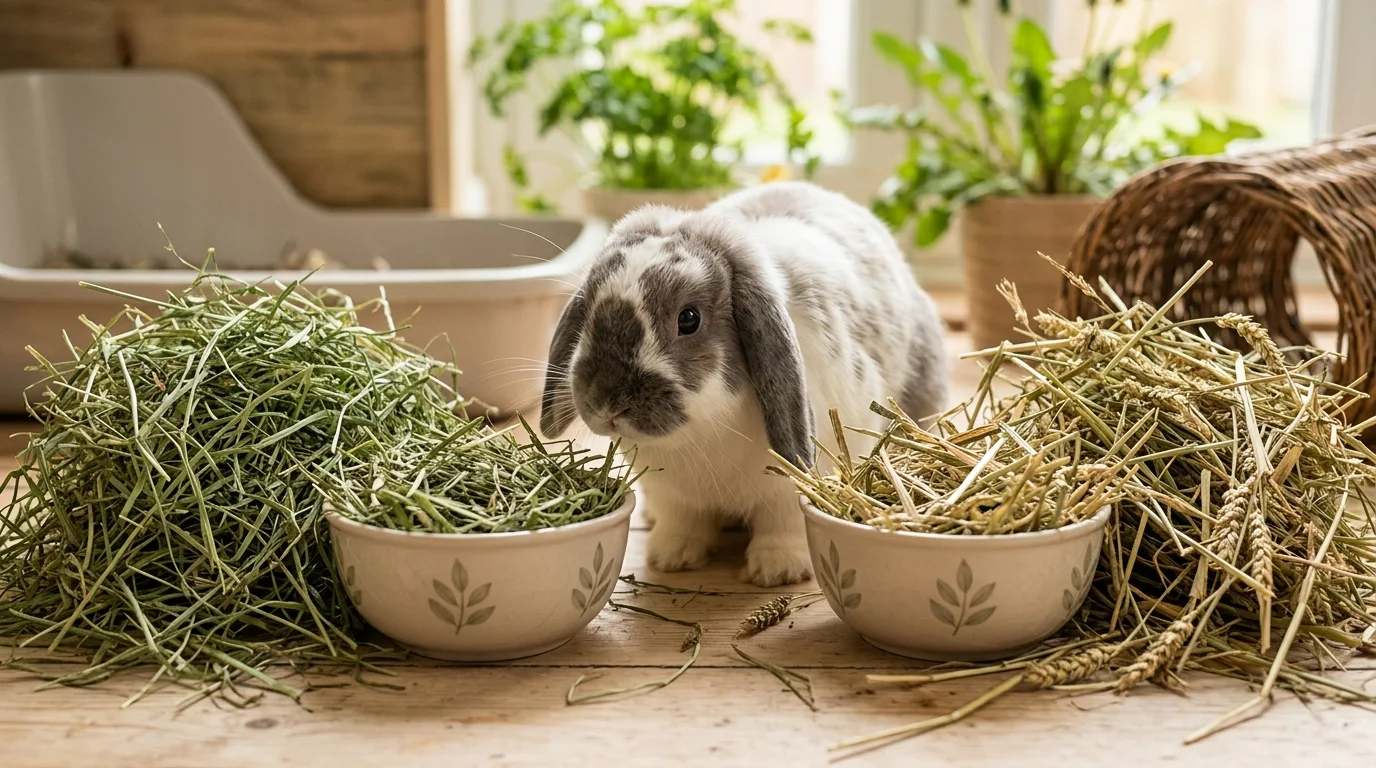
- First-cut hay: thicker stems, more seed heads, coarser texture, higher fiber
- Second-cut hay: finer stems, leafier texture, higher protein, higher fat and calories
- Both cuts count as grass hay, so both are safe as the bulk of an adult diet
How to Tell the Cuts Apart by Look and Feel
You can usually identify a cut before you ever check the label. Run your hand through the flake and look at what falls out.
- Stems. First-cut hay feels stiff and woody. Second-cut hay bends easily between your fingers.
- Seed heads. First-cut hay carries more dried seed heads and flower tops.
- Color. First-cut hay often looks a bit more yellow or straw-toned. Second-cut hay tends to look greener.
- Smell. Second-cut hay usually smells sweeter and more fragrant, which is part of why rabbits reach for it first.
Nutritional Differences Between First-Cut and Second-Cut Hay
The opening answer here is simple. First-cut hay trades calories for fiber, and second-cut hay trades some of that fiber back for protein and palatability.
| Nutritional Trait | First-Cut Hay | Second-Cut Hay |
|---|---|---|
| Fiber content | Higher, supports gut motility and tooth wear | Moderate to high, slightly lower than first cut |
| Protein content | Lower, fits weight maintenance | Higher, fits growth and recovery |
| Fat and calorie density | Lower, helps prevent obesity | Higher, helps rabbits gain or hold weight |
| Stem-to-leaf ratio | More stem, more seed heads | More leaf, softer texture |
| Palatability | Moderate, some rabbits skip the thick stems | High, most rabbits eat it readily |
Neither column is the “healthy” one and neither is the “unhealthy” one. The right column depends on the rabbit eating it, not on the hay itself.
When First-Cut Hay Is the Better Choice
First-cut hay earns its place with rabbits that need more fiber and fewer calories, not less nutrition overall. Reach for it in these situations.
- Your rabbit is an adult prone to weight gain or already carrying extra pounds
- Your rabbit is mostly sedentary, spending most of the day indoors and inactive
- Your rabbit has dental issues and needs the extra chewing resistance for natural tooth wear
- Your rabbit is recovering from GI stasis and needs maximum fiber once your vet says solid food is safe again
The payoff shows up at both ends of your rabbit. Teeth wear down evenly, and the litter box fills with more forage debris than food waste.
When Second-Cut Hay Is the Better Choice
Second-cut hay earns its place wherever appetite or extra nutrition matters more than calorie control. Reach for it in these situations.
- Your rabbit is a growing kit under six or seven months old, alongside its alfalfa ration
- Your rabbit is an underweight senior losing muscle mass
- Your rabbit is nursing or pregnant and needs more energy to support her body
- Your rabbit is a picky eater or recovering from illness and needs a hay that smells and tastes inviting
A nursing doe or a thin senior cannot afford to skip meals. Second-cut hay’s softness and aroma often close that gap.
Can You Mix First-Cut and Second-Cut Hay?
Yes. Mixing the two cuts gives your rabbit the coarse fiber of first-cut hay alongside the palatability of second-cut hay. Many owners feed a blend as their everyday default rather than choosing only one.
Offer both in the hay rack at once and let your rabbit self-select. Most rabbits eat some of each once they get used to having a choice.
Frequently Asked Questions
Does the cut number apply to orchard grass and meadow hay too, or just timothy?
Yes. Multi-cut harvesting applies to most cool-season perennial grass hays, not only timothy. Orchard grass, meadow hay, and brome all go through the same first-cut and second-cut cycle within a single growing season.
Is first-cut or second-cut hay better for a rabbit with bladder sludge?
Neither cut causes sludge on its own, since both are grass hays with safe calcium levels for adult rabbits. Total water intake and overall diet matter more. Avoid alfalfa hay for adult rabbits prone to calcium buildup.
Why is my rabbit refusing first-cut hay?
First-cut hay is stalkier and tougher to chew than your rabbit may be used to. A rabbit raised on second-cut or alfalfa hay can turn its nose up at coarse first-cut stems. Introduce it slowly by mixing the two cuts together.
Can I switch my rabbit between cuts without a transition period?
Yes. Hay is almost entirely fiber, so sudden switches between grass hay cuts rarely upset a rabbit’s stomach the way vegetable or pellet changes can. Watch for loose stool anyway, and slow down if you see any.
The Bottom Line
Judge the cut by your rabbit, not by a general rule. Weigh its age, body condition, and how eagerly it already eats hay before you choose.
A lean, sedentary adult usually does best on first-cut or a first-second blend. A growing kit, a thin senior, or a nursing doe usually does better on second-cut.
Whichever cut you land on, keep it unlimited and keep it fresh. Pair it with clean water at all times, since hay alone cannot do its job in a dehydrated gut.
For the full picture of what belongs in a daily bowl alongside that hay, see our guide on what rabbits can eat daily. New owners building a complete routine from scratch can start with Rabbit Care 101.