Rabbit vs Hare vs Pika: The Ultimate Comparison 2026
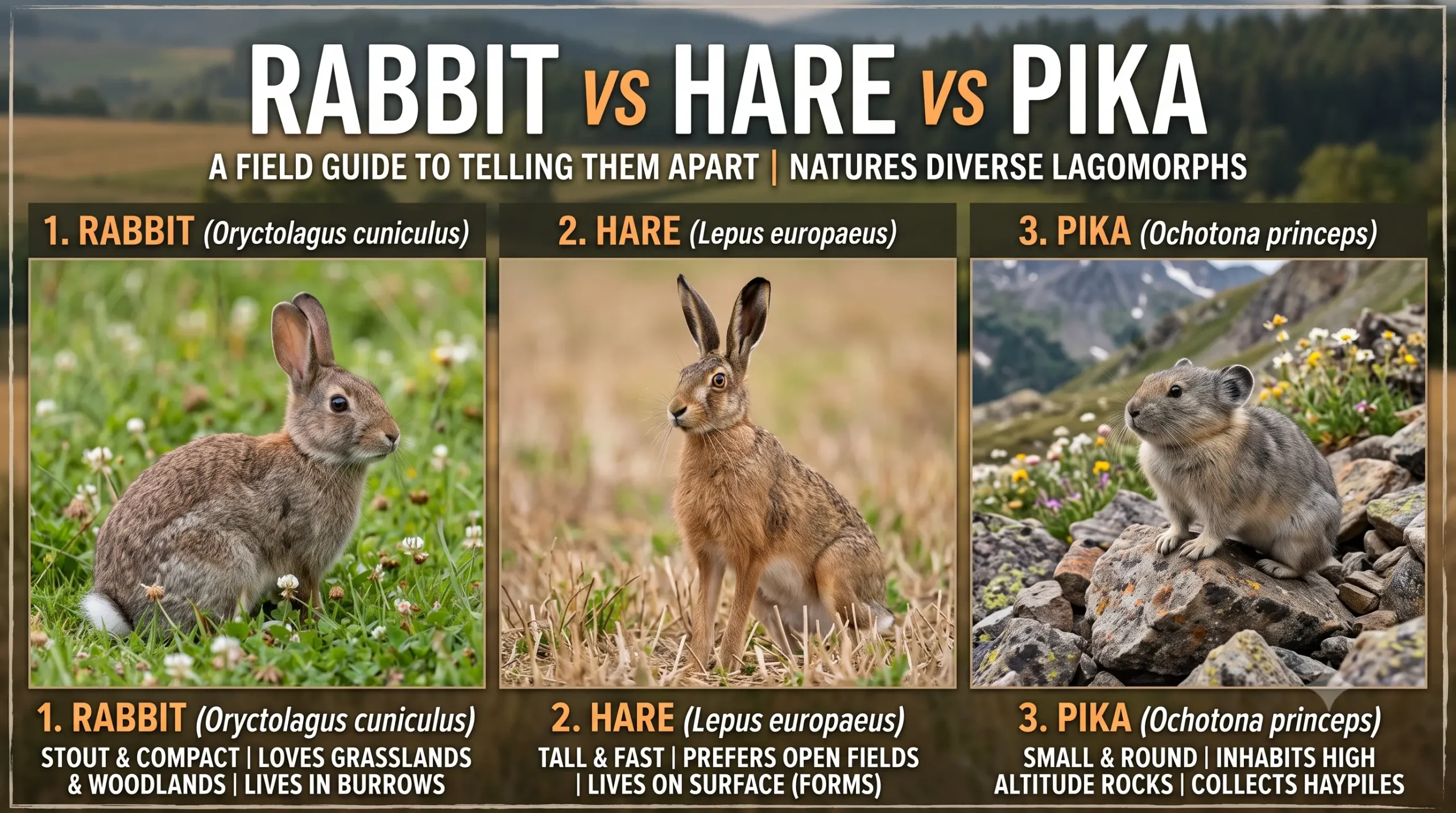
The main difference between rabbits, hares, and pikas lies in their physical anatomy, nesting habits, and social behaviors. While all three belong to the order Lagomorpha, rabbits are social burrowers with moderate ears and legs; hares are larger, solitary, long-eared runners that live entirely above ground; and pikas are small, round, virtually tailless mountain dwellers with short, round ears that live in rocky talus slopes.
Understanding the Order Lagomorpha
For a long time, rabbits, hares, and pikas were classified as rodents due to their continuously growing incisors. However, taxonomists eventually placed them in their own distinct order: Lagomorpha. Unlike rodents, which have only a single pair of upper incisors, lagomorphs possess a second, smaller pair of peg-like incisors tucked directly behind the primary front teeth.
Lagomorphs are strictly herbivorous or folivorous, utilizing a specialized digestive process called cecotrophy. To extract maximum nutrition from tough plant matter, they pass food through their digestive tract twice, reingesting soft, nutrient-rich pellets known as cecotropes. Despite these shared evolutionary traits, the family tree splits significantly between the long-eared Leporidae (rabbits and hares) and the diminutive Ochotonidae (pikas).
Rabbits: The Social Burrowers
Rabbits are the most familiar members of the lagomorph family. They are highly adaptable animals found on almost every continent, often living in close proximity to human environments.
Physical Characteristics of Rabbits
Rabbits generally possess compact, egg-shaped bodies, relatively short hind legs compared to hares, and long ears that are shorter than their heads. Their fur is typically soft and comes in various shades of brown, gray, and buff. When running, rabbits use a hopping motion, relying on nearby cover rather than sustained high-speed chases to escape predators.
Behavior and Nesting Habits
Most rabbit species, such as the European rabbit (Oryctolagus cuniculus), are highly social creatures that live in complex underground tunnel systems called warrens. The notable exception is the North American cottontail (genus Sylvilagus), which does not dig deep warrens but instead nests in shallow surface depressions. Rabbits are famous for their reproductive rate; they give birth to altricial young, meaning the kits are born blind, hairless, and entirely dependent on maternal care.
Hares: The Solitary Speedsters
Hares belong to the same family as rabbits (Leporidae) but are classified under a different genus, Lepus. They are built for life in wide-open spaces where hiding underground is not an option.
Physical Characteristics of Hares
Hares are significantly larger and leaner than rabbits. They possess exceptionally long hind legs, large hind feet, and very long ears, often tipped with black. Their skulls are structured differently to accommodate larger sensory organs, and their muscles are rich in dark fibers designed for sustained, high-speed running. Many hare species, like the snowshoe hare, undergo a seasonal molt, changing their fur from brown in summer to white in winter for camouflage.
Behavior and Survival Strategies
Unlike rabbits, hares are solitary animals that do not build underground homes. Instead, they rely on “forms”—shallow depressions in the grass or brush where they flatten themselves to avoid detection. When threatened, a hare’s primary defense is pure speed, with some species capable of reaching up to 45 miles per hour. Their young, called leverets, are precocial; they are born fully furred, with open eyes, and are capable of hopping around within hours of birth.
Pikas: The Vocal Mountain Dwellers
Pikas belong to the family Ochotonidae and the genus Ochotona. They look vastly different from their rabbit and hare cousins, often resembling large hamsters or guinea pigs at first glance.
Physical Characteristics of Pikas
Pikas are small, egg-shaped animals with short, rounded ears, no visible tail, and short limbs. Their compact bodies are an evolutionary adaptation designed to conserve heat in the cold, high-altitude environments they call home. They typically weigh between 75 and 290 grams, making them much smaller than even the smallest wild rabbit species.
Behavior, Haypiles, and Vocalizations
Pikas are famous for two distinct behaviors: “haymaking” and vocal whistling. Because they do not hibernate, they must survive harsh alpine winters by gathering vegetation during the summer. They lay grasses, wildflowers, and leaves out on rocks to dry in the sun, creating “haypiles” that they store deep within rocky crevices (talus) for winter food. Pikas are also highly territorial and use sharp, high-pitched whistles or barks to warn neighbors of predators or defend their foraging patches.
Side-by-Side Comparison: Rabbit vs. Hare vs. Pika
The table below highlights the key differences across physical traits, reproductive strategies, and habitats:
| Feature | Rabbit | Hare | Pika |
|---|---|---|---|
| Body Size | Small to medium (compact) | Medium to large (long, lean) | Very small (egg-shaped) |
| Ear Length | Long (shorter than head) | Very long (longer than head) | Short and rounded |
| Hind Legs | Moderate length | Extremely long and powerful | Short, equal to front legs |
| Nesting/Home | Underground warrens or burrows | Above-ground scrapes (forms) | Rocky talus slopes and crevices |
| Condition of Young | Altricial (blind, hairless) | Precocial (furred, eyes open) | Altricial (blind, helpless) |
| Social Behavior | Highly social (groups) | Solitary | Territorial (vocal colonies) |
Key Ecological Differences
The evolutionary paths of these three lagomorphs have been shaped heavily by their environments. Understanding their ecological niches helps explain why their physical forms diverged so drastically.
Reproduction: Altricial vs. Precocial
The difference in how their young are born is a direct reflection of their predator-avoidance strategies. Because rabbits raise their young in protected underground burrows, their kits can afford to be born vulnerable and undeveloped. Hares, living in open grasslands and tundras without physical shelter, must give birth to young that can run almost immediately to escape predators like coyotes, foxes, and eagles.
Habitat and Distribution
Rabbits prefer habitats with plenty of cover, such as forests, meadows, and brushy fields. Hares thrive in open environments like deserts, prairies, and arctic tundras where their speed and long-distance vision give them an advantage. Pikas are highly specialized for alpine and subalpine zones, living among broken rock piles (talus) where they can easily slip into tight spaces to escape predators and shelter from extreme weather.
Conclusion
While rabbits, hares, and pikas share a common ancestry within the order Lagomorpha, they have adapted to distinct ecological niches. Rabbits are social burrowers, hares are solitary open-country runners, and pikas are vocal, cold-hardy mountain dwellers. Recognizing these differences in anatomy, behavior, and habitat provides a deeper appreciation for the diversity of this fascinating animal group.
Frequently Asked Questions
Are rabbits, hares, and pikas rodents?
No, rabbits, hares, and pikas are not rodents. They belong to the order Lagomorpha. The primary anatomical difference is that lagomorphs have four incisor teeth in their upper jaw (two pairs, one behind the other), whereas rodents only have two upper incisors.
Can rabbits and hares interbreed?
No, rabbits and hares cannot interbreed. They belong to different genera and have a different number of chromosomes (rabbits typically have 44 chromosomes, while hares have 48), making hybridization biologically impossible.
Why do pikas make whistling sounds?
Pikas make high-pitched whistling sounds to communicate with other pikas, defend their territory from intruders, and warn their colony of approaching predators like hawks or weasels.
Which is faster, a rabbit or a hare?
Hares are significantly faster than rabbits. Designed for open-ground running, hares can reach speeds of up to 37 to 45 miles per hour (60 to 72 km/h), whereas rabbits rely on quick, zig-zagging bursts to reach burrows, topping out around 25 to 30 miles per hour.